
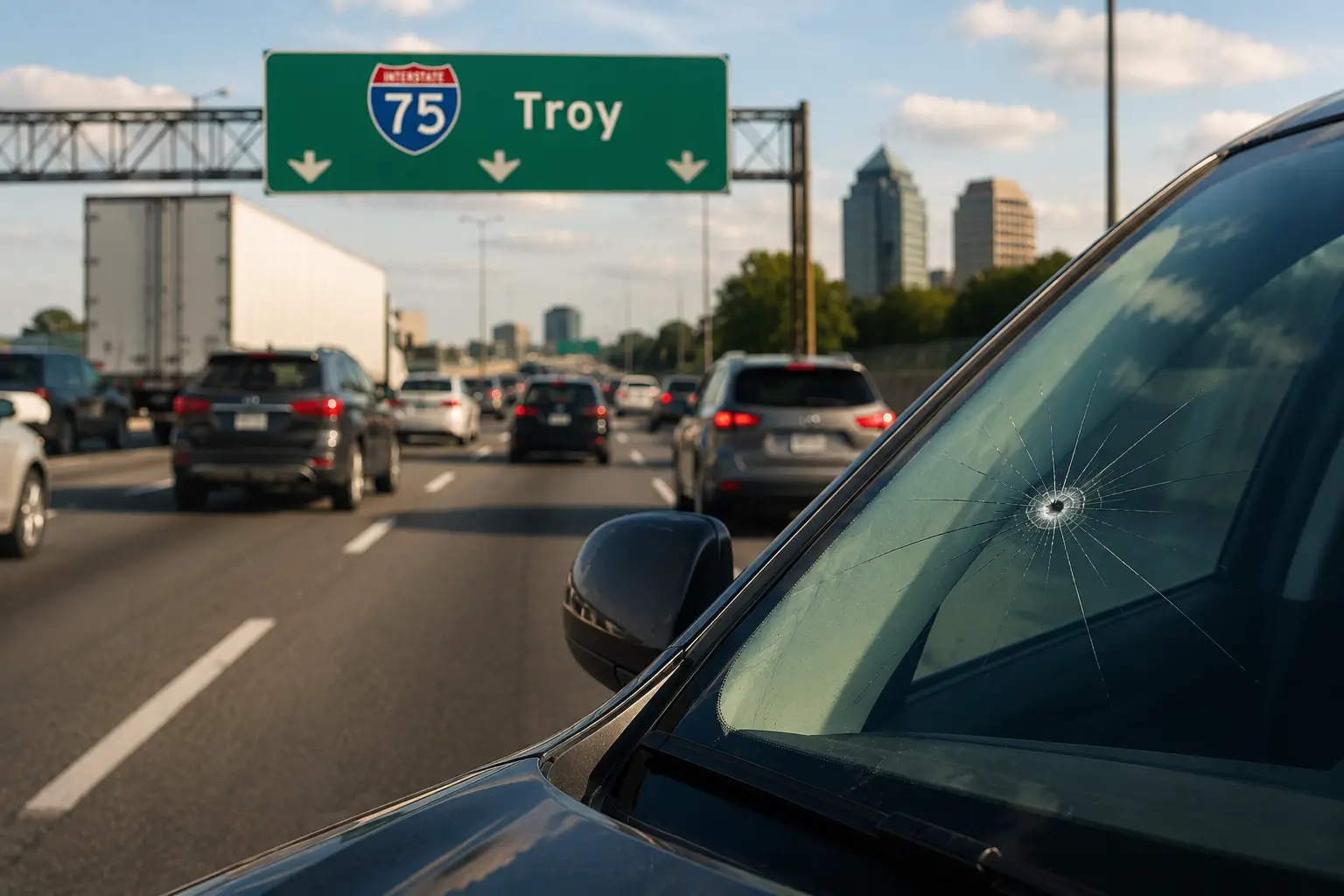
I’ve been replacing windshields in Southeast Michigan for more than 30 years. I’ve worked on cars when I-75 had less congestion, fewer construction zones, and nowhere near the volume of commercial trucks we see today. Back in the 90s, chips were common — but not like they are now. Today, I can almost predict when my phone will ring. The first heavy construction season hits. Traffic tightens on I-75 through Troy. And within days, drivers start calling about rock chips.
If you commute through Troy — especially near Big Beaver Road, 14 Mile, or the M-59 interchange — your windshield is under constant attack. It’s not bad luck. It’s physics, traffic density, and road conditions working against you. And if you ignore a small chip in Michigan weather, you already know what happens next.
Let me explain why I-75 traffic in Troy increases windshield chip risks — and what you can realistically do about it.
Why I-75 in Troy Is a Perfect Storm for Windshield Damage
I-75 through Troy isn’t just another stretch of highway. It’s one of the busiest corridors in Oakland County. Between daily commuters, delivery fleets, semis hauling gravel, and constant construction updates, the traffic density is high year-round.
Heavy trucks are the biggest contributor to windshield chips. When a dump truck accelerates, loose gravel shifts. When it brakes, debris slides. Even if a truck has a tarp, small stones escape. At 70 mph, a pebble becomes a projectile. I’ve removed hundreds of windshields where the damage pattern clearly showed high-speed impact — a sharp bullseye right at driver eye level.
Construction zones add another layer. Fresh asphalt, temporary lane shifts, loose aggregate — these are ideal conditions for flying debris. Every time lanes narrow near Crooks Road or Rochester Road, vehicles bunch up. When traffic tightens, your following distance shrinks. Less space means less reaction time when debris kicks up.
I’ve seen weeks where almost every call we received came from drivers who commute I-75 daily. That’s not coincidence. It’s environment.
The Physics Behind High-Speed Rock Chips
Back when I first started, windshields were simpler laminated glass without embedded sensors. Today, they’re structural components tied into vehicle safety systems. But physics hasn’t changed.
When you’re driving 70 mph and a truck ahead of you throws a small stone, the closing speed can exceed 100 mph depending on angles. That tiny rock carries enough force to fracture laminated glass. The outer layer cracks, while the inner layer usually holds.
At lower speeds — say neighborhood driving — a rock may bounce off harmlessly. On I-75 at highway speeds, the same rock becomes destructive.
Temperature also matters. Michigan mornings can start at 40°F and rise to 75°F by afternoon. Glass expands and contracts. If your windshield already has minor stress from highway impact, those temperature swings worsen it. That’s why I tell Troy drivers: the chip you see today could be a crack tomorrow.
Traffic Congestion and Following Distance Problems
One thing I’ve noticed over the years is how much closer people follow now. Maybe it’s impatience. Maybe it’s traffic design. But tailgating on I-75 is a major contributor to windshield damage.
When you follow too closely behind a semi or construction vehicle, you sit directly in the debris zone. Trucks kick rocks up from rear tires, and the closer you are, the less time debris has to fall harmlessly.
I always advise maintaining at least three to four seconds of following distance on the highway. It’s basic defensive driving. But during rush hour in Troy, especially near exit ramps and merging zones, maintaining that gap is tough.
The result? More chips. More stress cracks. More windshield replacements.
In my shop, when I hear a customer say, “It happened right after I passed a gravel truck,” I already know the story.
Seasonal Road Work in Troy Makes It Worse
Michigan winters are brutal on roads. Freeze-thaw cycles break pavement apart. By spring, road crews are patching, resurfacing, and rebuilding sections of I-75. Every construction project means loose materials.
Freshly resurfaced highways often have small leftover stones that weren’t fully compacted. As traffic flows over them, vehicles fling them backward. The first few weeks after resurfacing are especially dangerous for windshields.
I remember one construction season where we replaced nearly twice the normal number of windshields between May and August. Almost every driver mentioned passing through active work zones in Troy.
Construction cones don’t just slow you down — they increase your chip risk.
Modern Windshields Are More Vulnerable Than You Think
Here’s something many drivers don’t realize. Modern windshields are thinner than older ones. That doesn’t mean they’re weaker — they’re engineered differently. They’re lighter to improve fuel efficiency and designed to work with airbags and ADAS systems.
But thinner glass can be more susceptible to surface damage from high-velocity debris.
On top of that, today’s windshields often house:
- Forward collision cameras
- Lane departure sensors
- Rain sensors
- Heads-up display projection areas
When a chip forms in the wrong location, it’s not just cosmetic. It can interfere with sensor clarity or driver visibility. I’ve seen minor chips distort heads-up display projections, especially on newer vehicles.
In the 90s, a chip was an annoyance. Today, it can affect vehicle safety systems.
How Small Chips Turn Into Full Cracks on I-75
I’ve had customers tell me, “It was just a tiny dot yesterday.” That’s how it starts.
Here’s what happens. A rock hits your windshield on I-75. It creates a small bullseye or star chip. You keep driving. Highway vibration continues stressing the impact point. Temperature changes expand and contract the glass.
Within days — sometimes hours — a crack begins spreading from that impact. Once a crack exceeds a few inches, repair becomes unlikely. Replacement becomes the safer option.
In Michigan, the freeze-thaw cycle accelerates this process. Moisture enters the chip. Overnight temperatures drop. Water expands when it freezes. The crack widens.
That’s why quick repair matters. A simple resin repair is far cheaper than a full replacement.

Insurance Claims and Highway Damage
Most windshield damage from I-75 falls under comprehensive coverage. It’s considered road debris, not collision. Many Michigan drivers have full glass coverage with little or no deductible.
But here’s something I tell Troy commuters: filing a claim makes sense for large cracks, but small chips are often inexpensive to repair out-of-pocket. Sometimes paying directly avoids unnecessary claims history.
Every insurance policy differs. Always check with your agent. But don’t assume every chip needs to become an insurance file.
Prevention Strategies for Troy Drivers
You can’t eliminate all risk on I-75, but you can reduce it.
Maintain safe following distance, especially behind gravel trucks and construction vehicles. Avoid driving directly behind dump trucks whenever possible. If you see loose debris on the road, change lanes safely rather than driving through it.
If road construction is active near your exit, consider alternate routes during peak work weeks. Even a short detour can reduce exposure.
Most importantly, inspect your windshield weekly. Catching a chip early is the difference between a quick repair and a full replacement.
FAQ
Why do I get so many windshield chips driving on I-75 in Troy?
I-75 through Troy is one of the busiest highways in Oakland County, and it’s a perfect storm for windshield damage. The combination of heavy commuter traffic, construction vehicles, delivery trucks, and semis hauling gravel or loose materials means debris constantly gets kicked up into your lane. Even if a truck is tarped, small stones escape and travel at high speed.
At highway velocities, these pebbles carry enough force to chip or crack laminated glass. Construction zones make it worse, as freshly laid asphalt, temporary lane shifts, and loose aggregate increase the likelihood of flying debris. Drivers who follow too closely behind trucks are particularly vulnerable. Simply put, highway speed combined with traffic density and roadwork makes windshield chips far more common than on local or city streets.
Can a small chip from highway debris really spread that fast?
Yes — small chips can spread surprisingly quickly on highways like I-75, especially in Michigan. The combination of high-speed vibration, temperature fluctuations, and moisture accelerates crack growth.
A tiny bullseye or star chip can turn into a multi-inch crack within days if left untreated. Freeze-thaw cycles worsen the problem: water seeps into the chip, freezes overnight, and expands, widening the crack.
Even small road bumps or speed bumps can stress the compromised glass. That’s why early inspection and repair are critical. A quick professional resin repair not only restores structural integrity but also prevents the chip from becoming a costly full windshield replacement. Waiting too long allows the highway forces to turn a minor flaw into a major safety concern.
Is windshield repair safe after highway damage?
Absolutely — when done promptly and professionally. If the chip is small and hasn’t spread into a full crack, a resin-based repair restores structural integrity and prevents further propagation. The process involves cleaning the damaged area, filling it with high-quality resin, and curing it to bond with the laminated layers of glass. On modern windshields with embedded sensors, proper alignment ensures safety systems aren’t affected. Large cracks, chips near edges, or impact zones that compromise the structural integrity require full replacement for safety. On highways like I-75, early repair is especially important due to ongoing vibration and temperature changes. Professional technicians ensure that your repaired windshield maintains both optical clarity and strength, making it safe for daily commuting.
Does I-75 construction make windshield damage worse?
Yes, construction zones significantly increase windshield damage risks. Fresh asphalt, loose gravel, and ongoing resurfacing projects create ideal conditions for flying debris.
Even small stones that aren’t fully compacted can be flung backward by passing vehicles, especially trucks. Lane shifts, narrowed shoulders, and tight merges reduce following distance, giving drivers less time to react to debris.
During early phases of roadwork, gravel spray is most common, and vehicles traveling at highway speeds increase the impact force. I’ve seen entire weeks where almost every windshield call came from drivers who had recently passed through construction zones in Troy. Being aware of active construction, slowing down, and avoiding driving directly behind trucks can reduce the likelihood of chips, but risk remains higher than on open, completed stretches of the highway.
Should I file an insurance claim for highway chip damage?
It depends on your insurance coverage and the size of the damage. Most comprehensive policies in Michigan cover road debris under full glass coverage, often with little or no deductible. Small chips, however, are usually inexpensive to repair out-of-pocket and may not justify filing a claim. Filing for minor damage can unnecessarily affect your claims history or insurance records.
Large cracks, chips that impair visibility, or damage that interferes with safety systems almost always warrant a claim. The key is early assessment — a professional technician can advise whether a repair or replacement is necessary. Understanding your policy, checking deductibles, and communicating with your agent ensures that insurance is used appropriately and cost-effectively for highway-related damage.
Are modern windshields more fragile than older ones?
Modern windshields aren’t weaker, but they’re engineered differently than older models. They’re thinner and lighter to improve fuel efficiency and integrate with advanced safety systems like lane departure sensors, forward collision cameras, and heads-up displays.
While structurally strong, this design can make them more sensitive to high-velocity debris impacts. Chips that might have been cosmetic decades ago can now interfere with sensors or optical clarity, affecting safety systems.
Additionally, thinner glass responds more quickly to stress from temperature changes and road vibration, so small chips can propagate faster. The takeaway for Troy drivers is clear: early repair is more critical than ever. Protecting modern windshields isn’t just about avoiding replacement; it’s about maintaining sensor performance and driver safety.
Final Thoughts
I’ve worked on cars from the 90s to today’s high-tech models. I’ve watched I-75 grow busier every year. And if there’s one thing I can tell Troy drivers, it’s this: windshield chips aren’t random anymore. They’re predictable.
Highway speed plus heavy trucks plus construction equals increased risk. It’s not bad luck — it’s math.
If you commute I-75 daily, inspect your windshield often. Repair chips early. Maintain safe distance. And don’t ignore that small mark in your line of sight.
Your windshield isn’t just glass. It’s a structural safety component. Take care of it, and it’ll protect you for years to come.