When I started working on cars in the early 1990s, a windshield was just glass. You removed it, cleaned the pinch weld, applied urethane, set the new glass, and that was that. No cameras. No radar modules. No lane departure alerts lighting up dashboards.
Fast forward to today, and that windshield in your 2024 SUV is part of a safety network. It holds forward-facing cameras, rain sensors, light sensors, and sometimes even heads-up display projection systems. Around Troy, especially with drivers commuting daily on I-75, M-59, and Big Beaver Road, these systems matter. They’re not luxury features anymore. They’re standard safety equipment.
That’s why ADAS calibration services in Troy are no longer optional after certain windshield replacements. They are necessary for safety, performance, and liability protection. Let me walk you through what calibration really means, why it matters, and what every driver in Troy should understand before replacing their windshield.
What Is ADAS and Why Calibration Is Required
ADAS stands for Advanced Driver Assistance Systems. These systems use cameras, radar, and sensors to assist with braking, lane positioning, adaptive cruise control, and collision prevention.
Common ADAS features include forward collision warning, automatic emergency braking, lane departure warning, lane keep assist, adaptive cruise control, and traffic sign recognition. Most of these systems rely on a camera mounted behind the windshield.
When a windshield is replaced, even a slight shift in glass positioning — a few millimeters — can throw off the camera’s viewing angle. That angle determines how the system measures distance, reads lane markings, and detects vehicles ahead.
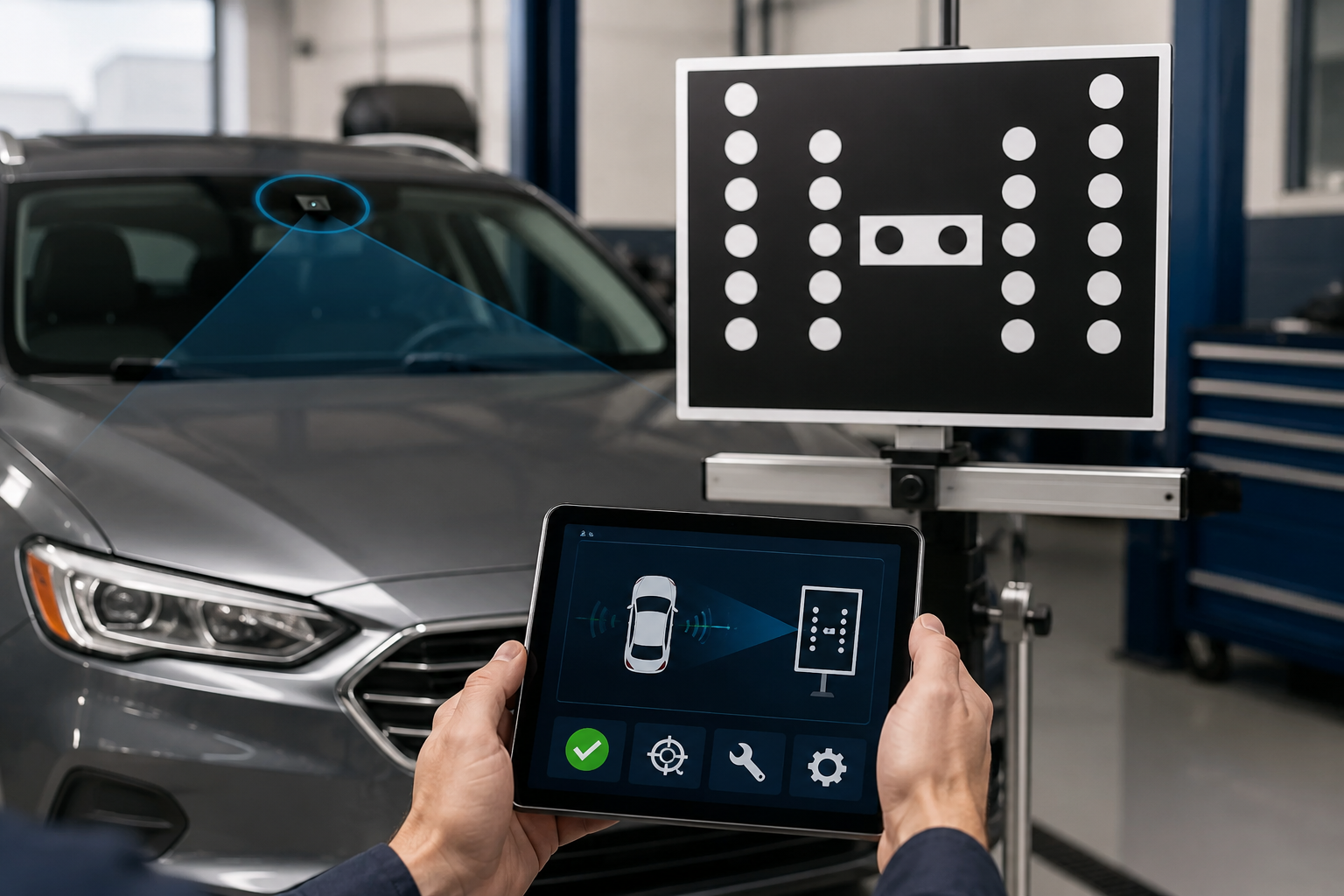
Calibration is the process of realigning the camera to manufacturer specifications after installation. Without proper calibration, the system may give false warnings, fail to detect obstacles, or react late.
In a busy area like Troy, where highway speeds and congestion are common, incorrect calibration isn’t just inconvenient. It can be dangerous.
Why Troy Drivers Need Proper ADAS Calibration
Troy isn’t a small rural town with light traffic. It’s a high-volume commuter city with heavy daily flow on I-75, Rochester Road, and Crooks Road. Drivers rely heavily on adaptive cruise control and lane assist in stop-and-go traffic.
If your ADAS camera is even slightly misaligned, your vehicle may:
- Trigger unnecessary collision alerts
- Drift improperly within lane markings
- Fail to brake at correct distances
- Disable certain safety features entirely
I’ve seen vehicles come into the shop with warning lights illuminated after a windshield replacement done elsewhere. The driver thought the glass was fine — until the lane assist began pulling incorrectly on Woodward Avenue.
Calibration ensures the system sees the road exactly as engineers intended.
In modern vehicles, the windshield is no longer passive. It is active technology.
Types of ADAS Calibration: Static vs Dynamic
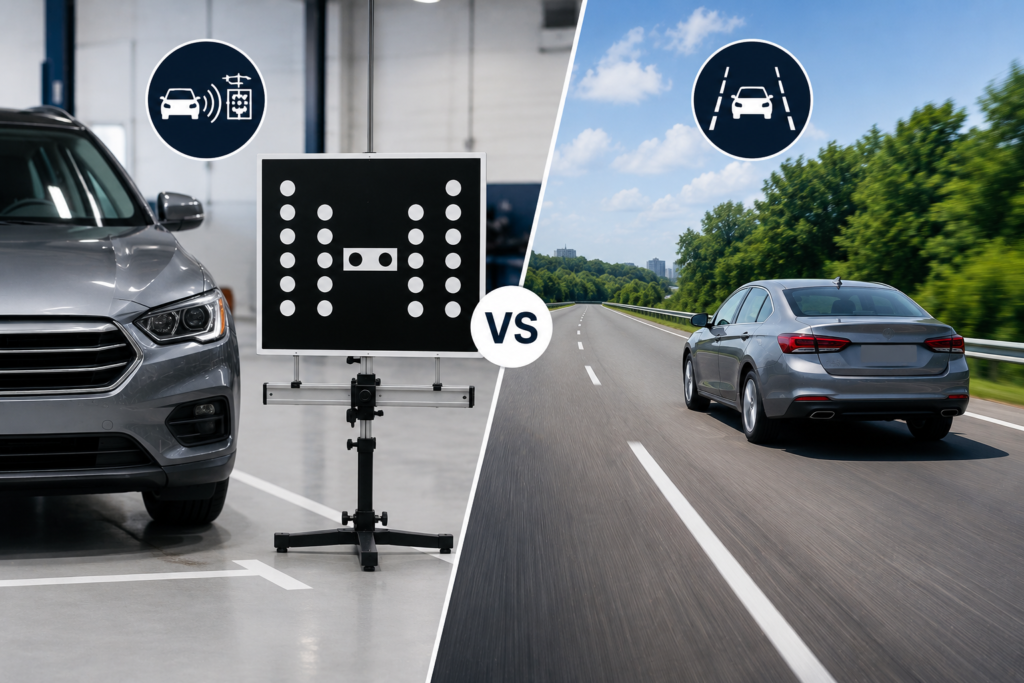
There are two main types of ADAS calibration, and Troy drivers should understand the difference.
Static calibration is performed in a controlled shop environment using specialized targets and measurement tools. The vehicle is positioned precisely, and calibration equipment aligns the camera using manufacturer guidelines. This process can take one to two hours depending on the vehicle.
Dynamic calibration requires driving the vehicle at specific speeds under controlled conditions so the system can recalibrate itself. This often means driving on clearly marked roads at highway speeds.
Many vehicles require both static and dynamic calibration. Some brands strictly require shop-based calibration to ensure accuracy.
In my experience, static calibration provides more controlled accuracy, especially for vehicles frequently driving on high-speed corridors like I-75.
Skipping calibration because “the system seems fine” is a mistake I’ve seen too often.
What Happens If You Skip ADAS Calibration?
This is one of the biggest misconceptions I encounter. Some drivers believe that if no warning light appears, calibration isn’t needed.
That’s not how these systems work.
The system might function — but it could be off by small margins. And small margins matter at 70 mph.
Improper calibration can lead to delayed braking response, inaccurate distance calculations, or inconsistent lane positioning. In an emergency braking situation, even half a second matters.
There’s also liability to consider. If an accident occurs and the ADAS system was not calibrated after glass replacement, that could create complications with insurance investigations.
Safety systems are engineered to precise tolerances. Guesswork has no place here.
How Much Does ADAS Calibration Cost in Troy?
ADAS (Advanced Driver Assistance Systems) calibration costs vary by make and model, and even by the specific calibration that is required for your vehicle. The average price for ADAS calibration is between $150 and $400.
In very rare cases, some vehicles require specialized manufacturer calibrations that only the manufacturer could do. Those will typically cost more due to the equipment required as well as the additional time to complete the job.
The good news is most insurance companies cover the cost of ADAS calibration if required for a windshield replacement using your auto policy. We will verify your coverage and explain any additional cost to you prior to completing the work.
At Save On Auto Glass, we use the highest quality of equipment and follow the exact specifications set forth by the manufacturer to calibrate your vehicle’s ADAS. If you have any questions about whether your vehicle requires any type of calibration, please contact us today for a free estimate.
While calibration adds to the overall replacement cost, skipping it to save money is not worth the risk.
Insurance and ADAS Calibration Coverage
Most ADAS calibration needs arise after windshield replacement. Since windshield damage typically falls under comprehensive insurance coverage, calibration may also be covered.
However, policies differ.
Some insurers include full calibration coverage when required by manufacturer guidelines. Others require documentation proving calibration necessity.
If your policy includes full glass coverage with zero deductible, you may pay little to nothing out-of-pocket. If not, calibration could be billed separately.
I always advise Troy drivers to contact their insurer and confirm:
- Is windshield replacement covered?
- Is ADAS calibration covered when required?
- Is there a deductible?
Clarity upfront prevents billing surprises later.
Why Professional Calibration Matters
ADAS calibration requires specialized equipment, training, and space. This is not a DIY task.
Technicians must follow manufacturer procedures precisely. Measurements must be exact. Targets must be positioned accurately. Environmental lighting conditions matter. Even tire pressure can influence dynamic calibration results.
Shops performing calibration should have proper certification and updated software access.
I’ve seen improper calibration attempts cause more problems than they solved. A quick reset with a scan tool is not the same as manufacturer-approved calibration.
In a city like Troy, where drivers rely on highway safety systems daily, professional calibration is critical.
Common Myths About ADAS Calibration
One myth is that only luxury vehicles need calibration. That’s no longer true. Many standard sedans and crossovers now include forward collision systems.
Another myth is that small windshield repairs require calibration. In most cases, minor chip repairs do not require recalibration because the camera position isn’t disturbed. Full windshield replacement is the common trigger.
Some drivers assume the dealership is the only place calibration can be done. While dealerships often provide calibration, many qualified independent shops also perform manufacturer-compliant procedures.
The key is not where it’s done — it’s how accurately it’s performed.
Frequently Asked Questions
Do all windshield replacements require ADAS calibration?
Not all windshield replacements require ADAS calibration. Older vehicles without forward-facing cameras, radar modules, or lane departure systems usually don’t need any calibration. However, most vehicles manufactured in the last five to eight years include some form of camera-based or sensor-driven driver assistance.
In these cases, even a slight misalignment during windshield replacement can affect system accuracy. Calibration ensures that adaptive cruise control, lane departure warnings, forward collision alerts, and other safety features function as intended.
In Troy, where drivers often navigate high-speed highways like I-75 and busy corridors such as Rochester and Big Beaver Roads, precise sensor alignment is crucial. Skipping calibration might not immediately trigger warning lights, but the systems could underperform, reducing both safety and reliability.
How long does ADAS calibration take?
The time required for ADAS calibration depends on the type of system and vehicle. Static calibration, performed in a controlled shop environment using targets and measurement tools, typically takes one to two hours.
Dynamic calibration requires driving the vehicle at specified speeds under controlled conditions so sensors can recalibrate automatically, which can add extra time depending on traffic and road conditions. Some modern vehicles require both static and dynamic calibration to meet manufacturer specifications.
For Troy drivers commuting on high-volume roads, it’s important to allow sufficient time for these procedures to ensure accuracy. Rushing or skipping steps can compromise safety systems, so professional technicians follow every guideline carefully. Proper calibration ensures adaptive cruise, lane assist, and collision avoidance systems work exactly as designed.
Can I drive without calibration after windshield replacement?
Technically, the vehicle may drive without calibration after a windshield replacement, but it’s not recommended. Without proper alignment, ADAS features like lane departure warnings, adaptive cruise control, and forward collision alerts may not function accurately.
Even small misalignments can cause lane drift, delayed braking response, or false alerts — particularly at highway speeds on I-75 or congested city roads in Troy. Safety systems rely on precise sensor positioning, so driving without calibration introduces risk.
Beyond safety, there could be liability concerns in case of an accident. Manufacturers specifically require calibration for proper functionality, and insurance companies may consider neglecting this step if an incident occurs. For both safety and compliance, always follow manufacturer guidelines and have ADAS properly calibrated after any windshield replacement.
Does insurance always cover calibration?
Insurance coverage for ADAS calibration depends on your policy. Many comprehensive insurance policies in Troy and Michigan cover windshield replacement, and some include calibration when it is manufacturer-required. However, coverage isn’t universal. Some insurers cover only the glass, leaving calibration as an additional expense.
Others may require documentation proving that calibration is necessary. Deductibles may also apply, depending on the plan. Before scheduling service, Troy drivers should contact their insurer to confirm: whether windshield replacement is covered, whether ADAS calibration is included, and if any out-of-pocket costs will apply.
Doing this upfront prevents surprises and ensures that your vehicle’s safety systems are professionally restored without unexpected bills. Proper insurance coordination guarantees that both glass and technology are protected.
What warning signs indicate calibration problems?
Warning signs that ADAS calibration may be off include dashboard alerts, lane assist pulling inconsistently, inaccurate collision alerts, or certain safety features being disabled. Drivers may notice the vehicle drifting slightly within the lane or adaptive cruise control maintaining incorrect following distances.
On newer vehicles with heads-up displays or lane departure systems, small visual distortions can appear if sensors aren’t aligned correctly. If any of these indicators occur after a windshield replacement, it’s critical to address them immediately.
Even if the car seems drivable, misaligned sensors compromise safety, especially on Troy highways like I-75 or during rush-hour traffic. Early detection and professional recalibration restore full system accuracy, ensuring collision avoidance, lane guidance, and driver-assist features function exactly as intended.
Is mobile ADAS calibration available in Troy?
Some providers in Troy offer mobile ADAS calibration using portable equipment, which can be convenient for busy drivers. However, mobile calibration is typically limited to simpler systems or minor adjustments.
Many vehicles still require static calibration in a controlled indoor environment for precise sensor alignment. Dynamic calibration may also need a combination of mobile and on-road procedures to meet manufacturer specifications.
While mobile service can save time, Troy drivers should ensure that technicians follow all manufacturer guidelines and use certified equipment. Improper calibration, even if performed on-site, can compromise lane assist, forward collision, or adaptive cruise systems.
Choosing a reputable provider who understands both mobile and stationary calibration ensures safety without sacrificing convenience.
Final Thoughts
I’ve watched vehicles evolve from basic transportation machines to rolling safety networks. The windshield used to be simple laminated glass. Today, it’s a mounting platform for advanced safety technology.
ADAS calibration services in Troy are not an upsell. They’re part of modern vehicle safety.
If your windshield is replaced and your vehicle has forward-facing cameras or lane assist systems, calibration ensures those systems perform as designed. On busy roads like I-75, that precision matters.
Protect your investment. Protect your safety systems. And never treat calibration as optional when it’s required.
Your windshield does more than keep wind and rain out. It helps your car see the road ahead.